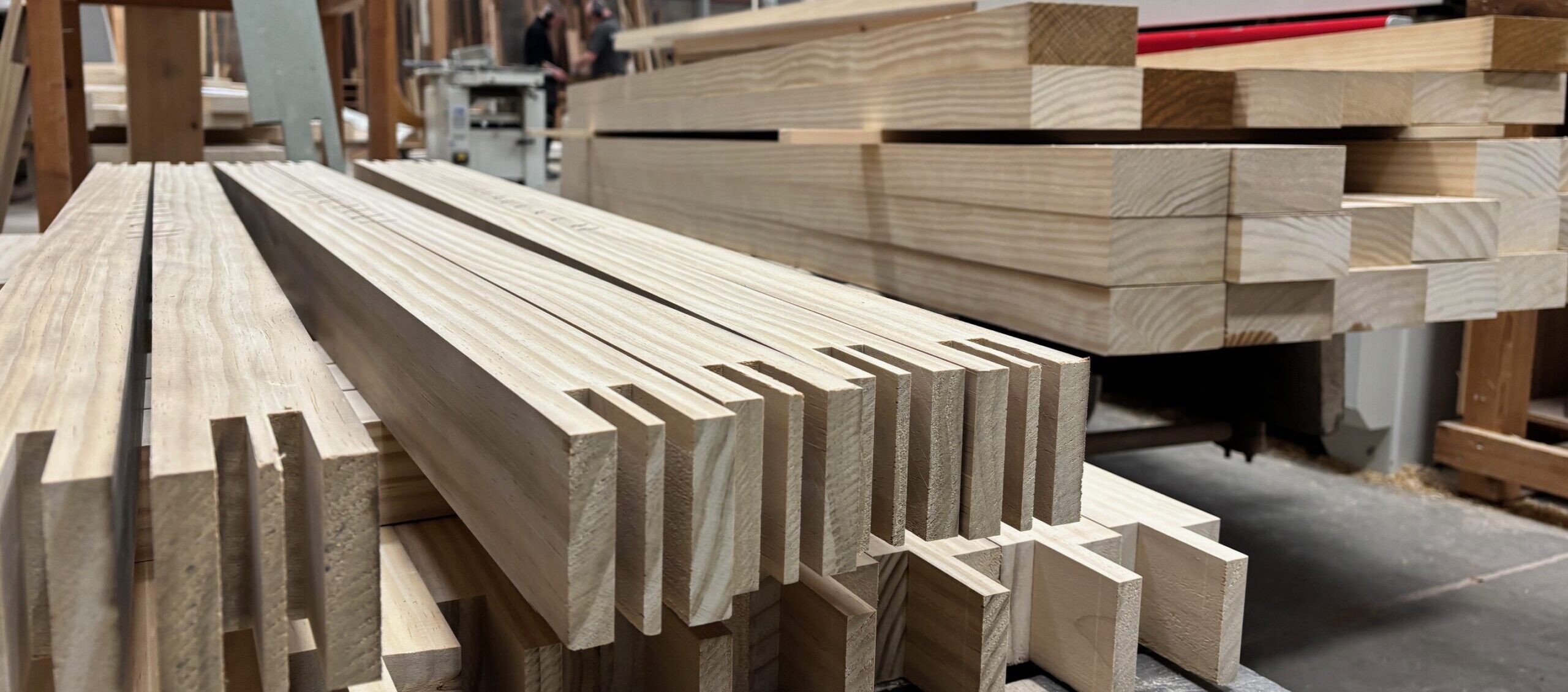
"Not all timber windows are equal. The species and treatment of timber you choose will determine how your windows perform — and how long they last — for decades to come."
When a homeowner or architect approaches us about new timber windows — particularly for a period property or listed building — one of the first questions we ask is: what timber are you specifying? The answer shapes everything: the performance, the maintenance burden, the planning acceptability, and the longevity of the finished product.
Over 40 years, we've worked with oak, Sapele, ash, pine, and many others. Each has its place. But for exterior timber windows — especially in the UK's wet climate — we increasingly specify Accoya as our material of choice. Here's why.
Accoya is not a species of tree. It's a process. Radiata pine — a fast-growing, sustainable softwood — is put through a chemical modification process called acetylation. In simple terms, the wood's cell structure is permanently changed: the free hydroxyls that would normally attract water are replaced with acetyl groups, which don't absorb moisture.
The result is a timber that behaves in a fundamentally different way to untreated wood. It doesn't swell, shrink, warp or rot in the way that conventional timber does — because the very mechanism that causes those problems has been removed at a molecular level.
.
50+Year durability
Above ground, independently tested to Durability Class 1
75% Less swelling
Versus untreated pine — dramatically fewer paint failures and joint issues
C1 Durability class
The highest biological durability rating — same class as teak
FSC Certified source
Fully certified sustainable timber supply chain
When we compare Accoya against the timbers we've historically used for exterior joinery, the differences are significant — and they matter directly to how a window will perform over its lifetime.
Exceptional Durability
Accoya achieves Durability Class 1 — the highest possible rating under EN 350. It resists rot, fungal decay, and insect attack without relying on toxic chemical preservatives. Independently tested for 50+ years above ground.
Dimensional Stability
Timber windows fail most often because wood moves — it absorbs moisture, swells, and distorts, breaking paint films and misaligning joints. Accoya moves up to 75% less than untreated timber. This means fewer paint failures, tighter seals, and longer service intervals.
Superior Paint Adhesion
Because Accoya doesn't swell and shrink with moisture cycles, paint and stain finishes last significantly longer than on conventional timber. For homeowners, this means less maintenance. For heritage projects, it means a consistently high-quality finish year-round.
Genuine Sustainability
Accoya is made from fast-growing, FSC-certified Radiata pine — not tropical hardwood. The acetylation process uses acetic anhydride, which reverts to acetic acid (vinegar) during the process and is fully recyclable. It's the most credible sustainable choice in premium exterior joinery.
Conservation & Planning Acceptance
Conservation officers and planning authorities across the UK are increasingly accepting Accoya as an appropriate material for heritage and listed building work. Its stability and performance profile makes it a credible alternative to tropical hardwoods that are becoming harder to source and specify.
Thermal Performance
Accoya has a lower thermal conductivity than many hardwoods. When combined with modern double or triple glazing units, Accoya windows can comfortably meet current Building Regulations requirements — even in retrofit situations on older properties.
This comparison covers the four timber species most commonly specified for exterior UK joinery. It's not a theoretical comparison — it's drawn from our direct manufacturing experience across 40 years.
| Property | Accoya ✦ | European Oak | Sapele |
|---|---|---|---|
| Durability Class (EN 350) | Class 1 (50+ yrs) | Class 2 (25+ yrs) | Class 3 (15+ yrs) |
| Dimensional stability | ●●●●● | ●●●○○ | ●●○○○ |
| Paint retention | Excellent | Good | Moderate |
| Conservation acceptance | Growing | Established | Varies |
| Suitable for heritage profiles | ✔ Yes | ✔ Yes | ✔ Yes |
| Premium cost vs softwood | High (worth it) | High | Medium |
One of the most frequent questions we receive from architects and conservation officers is: "Will Accoya be accepted for this listed building application?" The honest answer is that acceptability varies by local authority — but the trend is firmly in Accoya's direction.
Local Authorites have moved towards accepting modified timber products where they can demonstrate equivalent or superior performance to the materials originally used. Accoya, with its Class 1 durability rating and dimensional stability profile, increasingly fits that brief — particularly where the traditional specification would have been high-quality hardwood.
Critically, Accoya takes profiles and mouldings in exactly the same way as conventional hardwood. We can machine it to match original Victorian or Georgian sightlines, reproduce heritage mouldings, and manufacture sliding sash windows to period specification — with none of the movement problems that can affect less stable timbers over time.
✔ Our Experience with Accoya on Heritage Projects
If you're preparing a listed building application and need technical support on material specification, we're happy to provide input at the pre-application stage. This kind of early engagement often prevents costly revisions later.
The joinery industry has a complicated relationship with sustainability. Tropical hardwoods like iroko, teak, and opepe have been used for decades in exterior joinery — but their supply chains are often impossible to verify, and deforestation concerns are legitimate.
Accoya represents a genuinely credible alternative. It begins as FSC-certified Radiata pine — one of the world's most sustainably managed timber species. The acetylation process uses no heavy metals, biocides, or persistent organic pollutants. The by-products of the process are food-safe. At end of life, Accoya can be composted or biomassed.
We hold FSC and PEFC chain-of-custody certification. When you specify Accoya windows through us, you receive full documentation of the material's origin and certification — important for BREEAM assessments, planning conditions, and clients who care about where their materials come from.
🌍 Our Environmental Credentials
Accoya is not always the right answer — but it's the right answer more often than many people realise. Here's our honest guide:
Period & Character Properties
If you have a Victorian, Edwardian, or Georgian home and want new windows that look original but perform better than the originals ever did — Accoya is the specification. Stable, durable, and beautifully paintable.
Listed & Conservation Area Properties
Where planning requires a timber window that performs reliably over decades without repeated maintenance — Accoya is increasingly the preferred specification. We can support your planning application with technical data if required.
High-End New Build
For developers and self-builders who want to specify once and not revisit the decision for 30 years, Accoya's extended maintenance interval and durability makes it excellent value over the lifetime of the building.
Exposed or Coastal Locations
Seaside and exposed hillside properties place exceptional demands on exterior joinery. Accoya's resistance to moisture movement, salt air, and wind-driven rain makes it significantly more resilient than conventional options in these conditions.
We're one of a small number of Accoya Approved Manufacturers in the UK. Based in Chester, we manufacture bespoke timber windows, doors, and joinery for residential and commercial clients across the North West and beyond.
01244 371571 · enquiries@parryjoinery.co.uk · parryjoinery.co.uk
