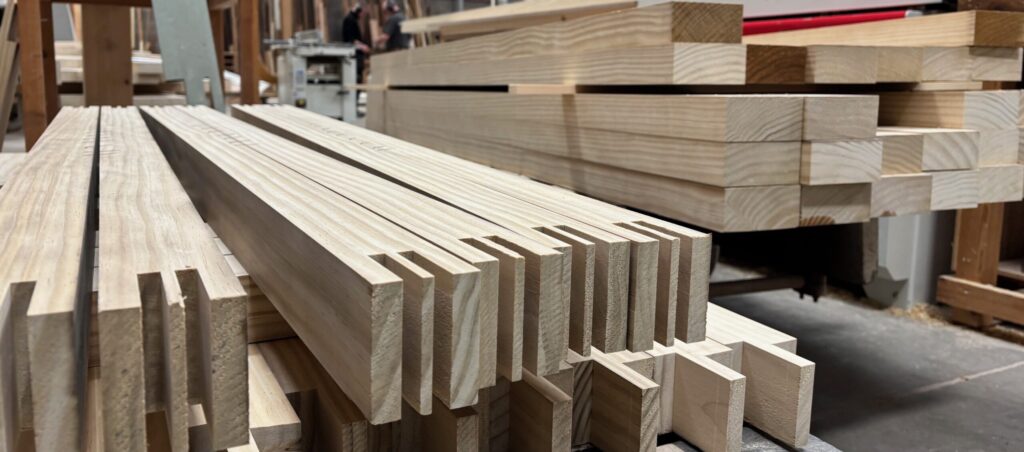
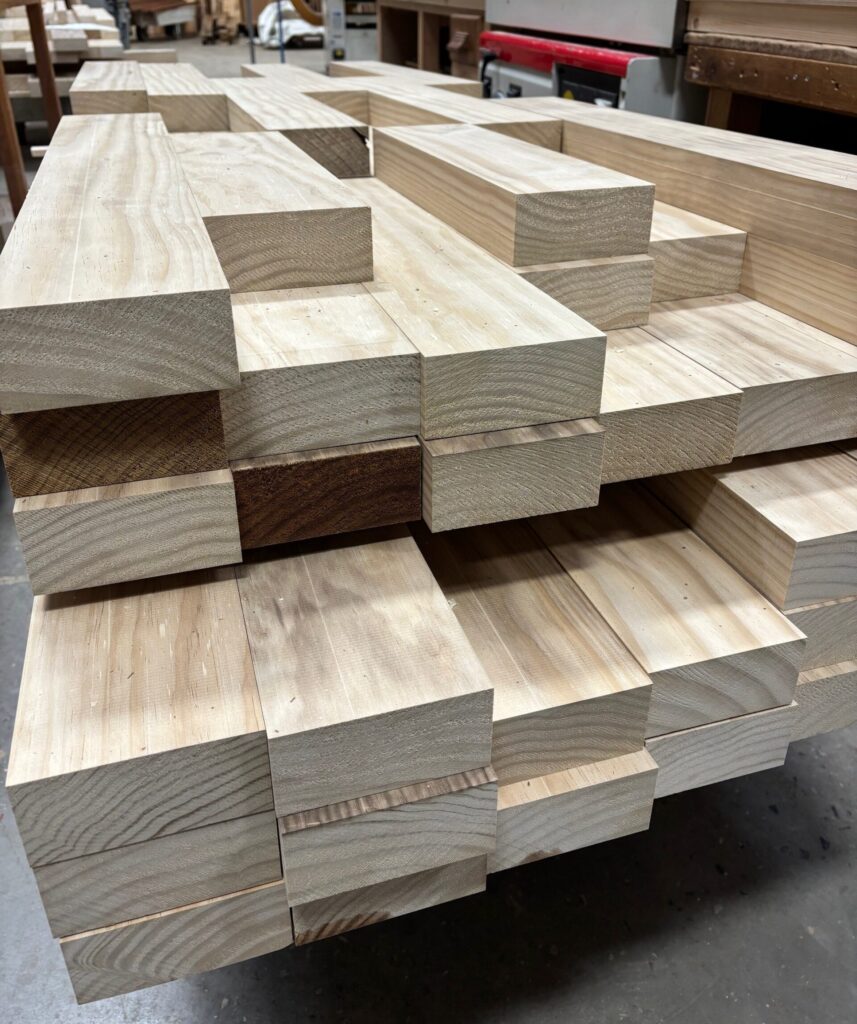
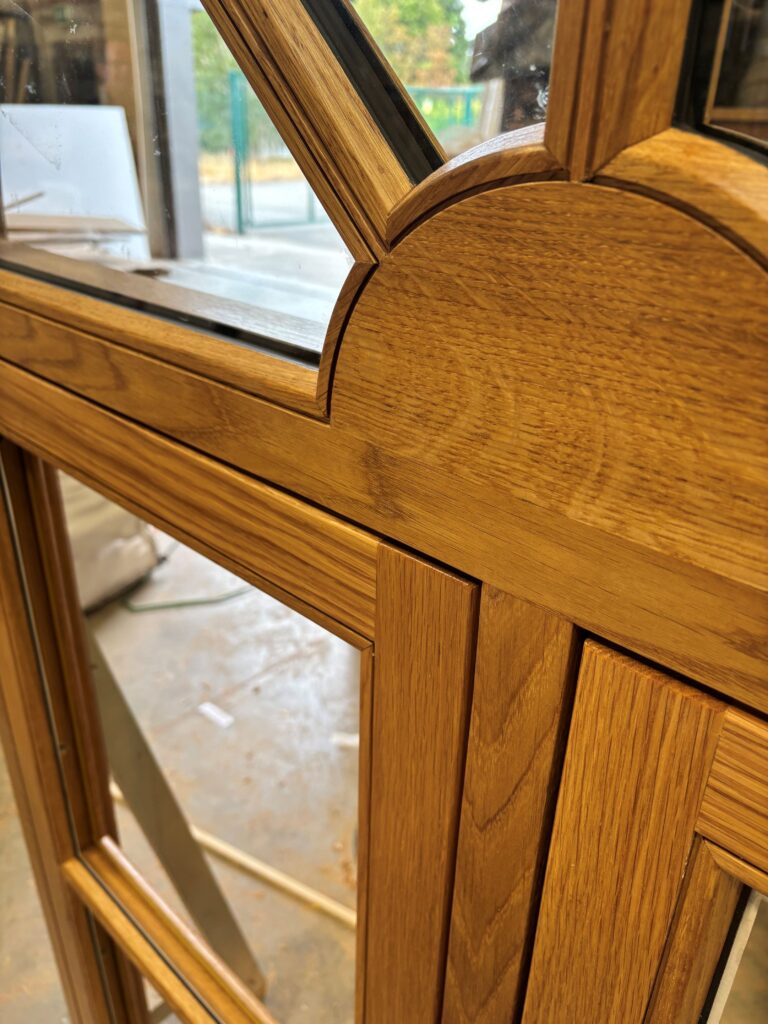
European Oak
The benchmark for staircases, cabinetmaking and ecclesiastical work — pews, screens, carving. Strong, durable and ages to a rich, dignified colour.
Every project starts with the same question: what does this timber need to survive? Exposure, load, movement and finish all point to a different species. Below is our working reference — the timbers we specify most often, and where each one earns its place.
Accoya is radiata pine put through an acetylation process that permanently changes its cell structure, so the timber stops absorbing and releasing moisture the way untreated wood does. The result is a softwood that outperforms most hardwoods for stability and decay resistance — with a 50-year above-ground guarantee — while machining, glueing and finishing like a well-behaved softwood.
As an Accoya Approved Manufacturer, we specify it routinely for external doors, windows and frames where movement and rot are the real risks — a lower-impact, FSC-certified alternative to slow-grown tropical hardwood.
Windows, doors, high-class joinery
The benchmark for staircases, cabinetmaking and ecclesiastical work — pews, screens, carving. Strong, durable and ages to a rich, dignified colour.
The most valuable of the white oaks, with a denser, closed cellular structure (tyloses) than red oak varieties. As with any timber, performance outdoors depends on correct detailing, finishing and ongoing maintenance.
Deep reddish-brown heartwood with a cedar-like scent when cut. Works cleanly by hand or machine — a firm favourite if you do not want Accoya.
Known as African Teak — nearly as durable, though less dimensionally stable. Starts yellow and deepens to rich brown; can carry hard calcium deposits that darken the surrounding grain.
Sometimes called Sipo Mahogany, related to the true mahoganies and arguably the finest available today. Suits furniture, worktops and high-class exterior joinery alike.
White, dense and straight-grained. Perishes quickly in ground contact, so we keep it indoors — furniture and internal joinery are its natural home.
Fine, short grain that machines cleanly, especially once steamed. Resists compression and splitting well — equally at home in furniture or stairs.
Pale, fine-grained hardwood. Birch ply is among the strongest, most dimensionally stable plywoods available — just not for exterior use.
A fine-grained, stable and easy-working timber, despite technically being a hardwood. A dependable choice for cabinet work, framing and painted furniture.
Internal doors, internal woodwork and mouldings
A high-load structural softwood used extensively in construction. Strong and reliable in the right application, but we wouldn’t specify it for external doors.
Tight, straight grain with few knots and genuine natural decay resistance. Built for posts, decking, fencing and shingles — weathers to a distinctive silver-grey.
Stability by design, not just by species
Wood fibre residuals bonded under heat and pressure into a dense, uniform panel. Ideal for shelving, mouldings and internal joinery; moisture-resistant grades are available.
An acetylated MDF-grade panel — the same acetylation technology behind Accoya, built into board form. Where standard MDF fails outdoors within a few years, Tricoya carries a genuine long-term exterior guarantee, making it our choice for fascias, soffits, cladding and other panel work MDF can’t handle.
Finger-jointing removes the weak points — knots, splits, staining — and produces long, stable lengths timber can’t offer on its own, opening up applications solid sections can’t reach.
Exposure, budget and finish all change the answer. Tell us what you’re building and we’ll recommend the right material for it.
Timber is a natural material. Even when correctly specified, finished and maintained, it will move — expanding, contracting and settling slightly with seasonal changes in temperature and humidity. This is normal, expected behaviour, not a defect.